Alicia E. Ellis, PhD
Alicia E. Ellis is an Associate Professor of German and Department Chair of African American Studies at Colby College in Maine. Her book in progress is an essay collection, Feminist Piecework: Assembling Black Diasporic Life.
What does a life look like when it refuses to resolve into a coherent story?
My work begins with the pressure to cohere: the expectation that a life should become orderly, narratable, and legible to the institutions that record or evaluate it. My current book project, Feminist Piecework: Assembling Black Diasporic Life, develops the convex self as one of its organizing figures: a subject shaped by curvature, interruption, and recurrence rather than linear progression. The figure comes from a body that has had to sustain scholarly labor through conditions, including chronic illness, for which institutions rarely make room. It refuses the clinical narrative that moves from symptom to diagnosis to recovery. That refusal isn’t a theoretical position first; it’s a consequence of an arc that was never available. The chapters move through genealogy, embodiment, credibility, and bureaucracy, asking in each register what a life does when it will not hold still.
How do you read German-language, Caribbean, African American, and transnational Black diasporic texts as one interpretive act rather than four adjacent fields?
The academy, the immigration file, the medical report, and the literary archive are among the many institutions and records that have their own protocols for what counts as evidence of a self. I read across German-language, Caribbean, African American, and transnational Black diasporic texts not to prove they speak in one voice. Heinrich Heine’s “Das Sklavenschiff” narrates the slave trade entirely through the ship captain’s voice; enslaved people are never interiorized, existing only as cargo forced to dance for their own resale value. I put that poem beside Derek Walcott’s “The Sea is History,” which answers the silence that Heine’s form enacts. Walcott’s guide speaks back, insisting that the sea holds a history no ledger recorded. Neither poem explains the other. Read together, they show what a form does when the trouble isn’t the plot, but who gets to narrate it.
What can literary form do that institutions cannot?
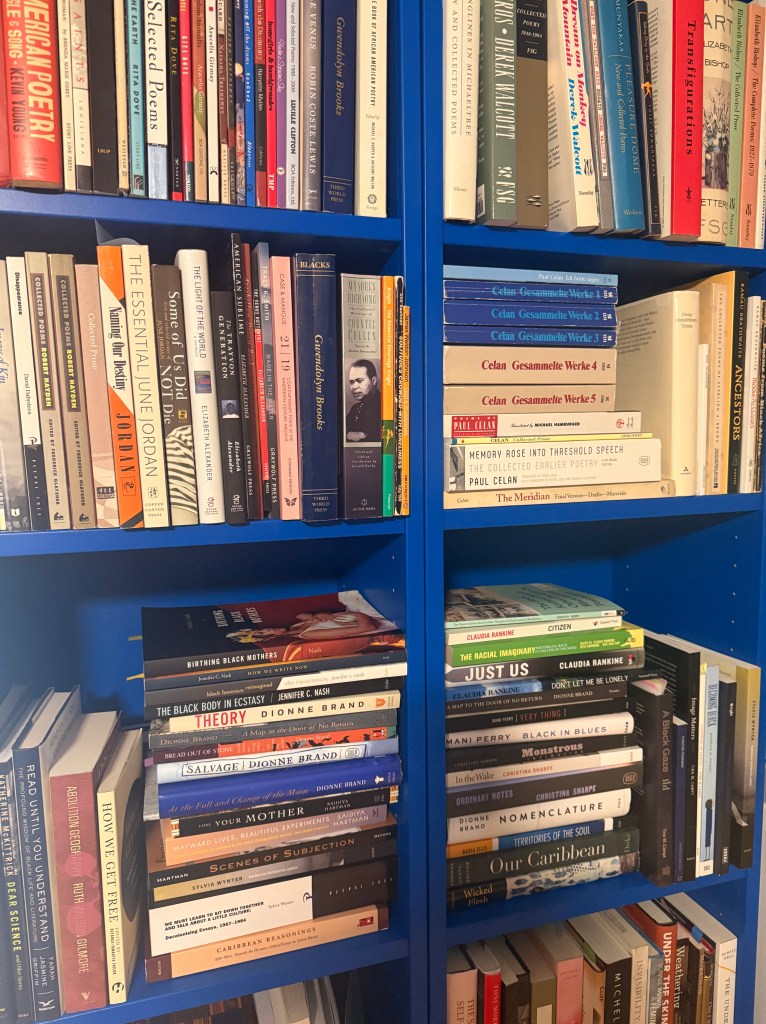
Feminist Piecework argues that the essay is a Black feminist method for thinking from what institutions cannot document, stabilize, or narrate. The essay is an attempt, not a solution. It is provisional, sometimes raw, and willing to remain unfinished rather than offer a coherence it has not earned. I take the anecdotal seriously in this sense: not as smallness, but as internal knowledge that survives being turned into someone else’s case study. My first book on Franz Grillparzer asked who gets to command language and who is made available to others’ interpretation in nineteenth-century Austrian drama; my readings of Dionne Brand, Claudia Rankine, Edwidge Danticat, and Heinrich Heine ask whether literary form can hold discontinuity without converting it into lack.
Areas of Research
German Literature (1789-1914) | African American and Caribbean Literature | Black European Studies | Black German Studies | Black Feminist Poetics | Short Prose | Experimental Prose | Speculative Fiction
People
Heinrich Heine | Andrea Levy | Audre Lorde | Sam Selvon | Derek Walcott | Edwidge Danticat | Sharon Dodua Otoo | Saidiya Hartman | Claudia Rankine | Dionne Brand